Xander Flores · 13 October 2026
How Urban Expansion Patterns Shape Material Choices for Biodegradable Flooring Production
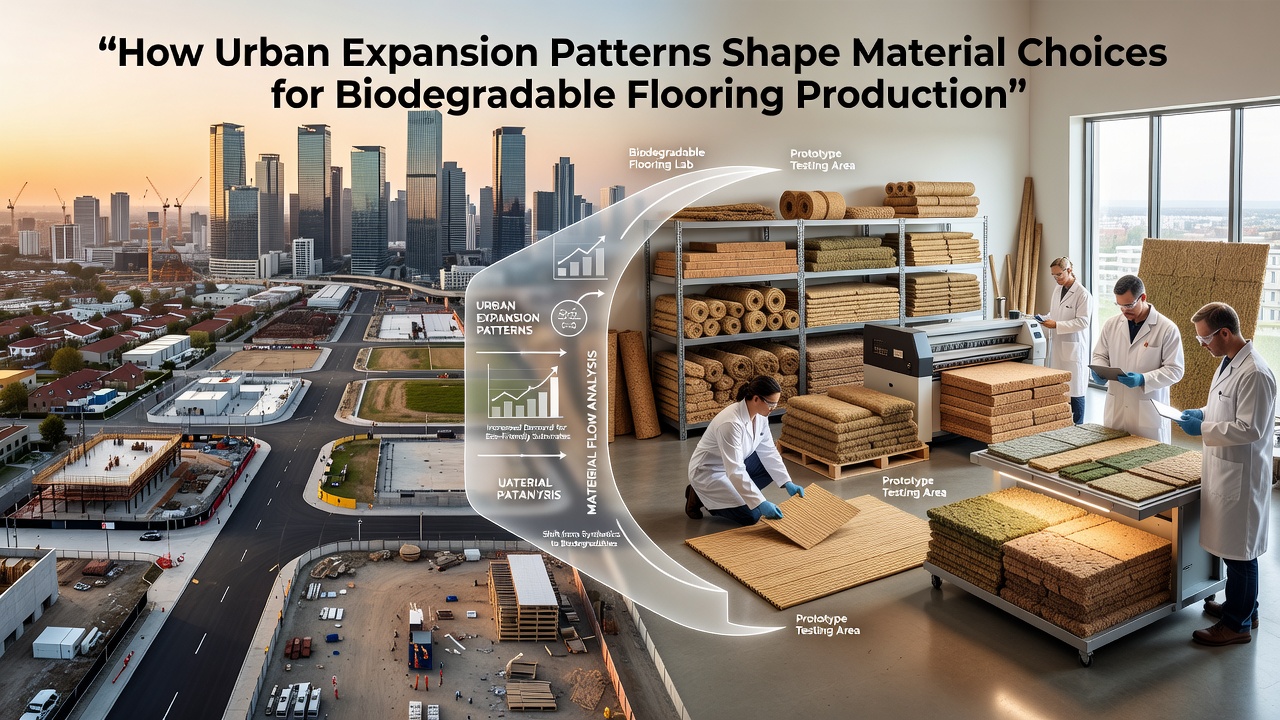
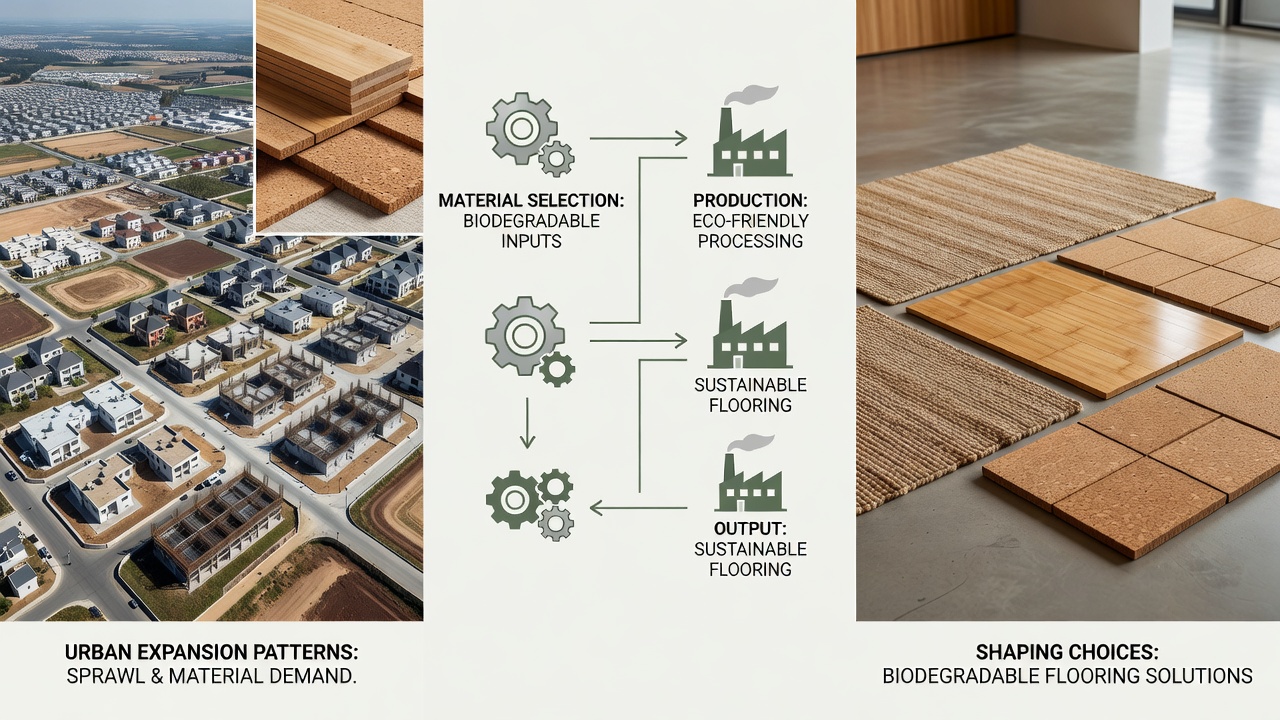
Urban expansion patterns continue to influence material selection for biodegradable flooring production as cities grow outward and consume surrounding land at accelerating rates. Data from global urbanization studies show that metropolitan areas worldwide added over 1.2 million hectares of built-up land between 2015 and 2025, creating direct pressure on biomass sources traditionally used in floor coverings. Researchers tracking these shifts note that proximity to expanding city edges determines which agricultural residues and fast-growing plants become economically viable for manufacturers.
Resource Availability at Urban Peripheries
Patterns of sprawl often leave fragmented farmland where crops such as hemp, straw, and bamboo remain accessible yet change in volume and type each year. Observers note that cities expanding along river corridors tend to favor materials derived from wetland reeds and fast-regenerating grasses because flood zones limit conventional construction while supporting these plants. In contrast, inland cities pushing into former orchards generate larger supplies of wood chips and nutshell residues that processors convert into binders for bio-based tiles.
Studies released in 2025 by the Food and Agriculture Organization indicate that 68 percent of new biodegradable flooring feedstock now originates within 150 kilometers of major urban centers, a reversal from patterns observed two decades earlier when sourcing relied more heavily on remote plantations. This geographic compression shortens supply chains and reduces transport emissions, yet it also forces producers to adapt formulas when seasonal harvests fluctuate due to changing land-use zoning.
Material Substitution Driven by Land-Use Pressure
As residential development claims former pasture, manufacturers turn to urban green-waste streams including tree prunings and park maintenance clippings. These inputs replace earlier reliance on dedicated fiber crops that now compete with housing. Production records from facilities in the American Midwest and the European Rhine-Ruhr region document a 34 percent increase in recycled wood content between 2022 and 2025, while virgin bamboo imports declined in the same period.
What's interesting is how zoning regulations around protected agricultural belts further steer choices toward invasive species removal programs. Cities in Australia and Canada have implemented mandates requiring developers to clear specific non-native plants, and the resulting biomass enters flooring supply chains through municipal contracts. Such policies create steady, localized material flows that stabilize pricing for manufacturers located near the urban edge.
Regulatory Frameworks and Certification Requirements
Building codes updated through October 2026 increasingly tie floor covering approvals to documented local sourcing distances. The European Union’s revised Construction Products Regulation now requires environmental product declarations that list feedstock origins, pushing producers to document how urban expansion zones supply raw inputs. Similar documentation rules appear in updated standards from Singapore’s Building and Construction Authority and from several Canadian provincial governments.
These requirements favor materials whose growth cycles match the pace of city growth. Mycelium-based composites, for instance, reach harvest readiness in weeks rather than years, allowing production facilities to scale output in step with new housing starts. Research published by Wageningen University shows mycelium tiles can incorporate up to 40 percent urban wood waste while maintaining required durability ratings for commercial installations.
Processing Technology Adaptations
Equipment suppliers have responded with modular pressing lines that accept variable particle sizes common in mixed urban biomass streams. Facilities operating near rapidly growing secondary cities in Southeast Asia report using smaller batch reactors that switch between straw, coconut coir, and coffee husk feedstocks within single production shifts. This flexibility reduces downtime when one source becomes temporarily unavailable due to new land conversion projects.
Energy consumption data collected by the International Energy Agency’s buildings program reveal that plants located within urban expansion corridors achieve 12 to 18 percent lower drying costs because they can draw residual heat from nearby district energy systems or waste-to-energy plants serving the same growing population. Such integration further influences which biodegradable formulations remain cost-competitive.
Conclusion
Urban expansion patterns continue to redefine the feedstock landscape for biodegradable flooring by concentrating biomass resources near production sites while simultaneously altering which plant species remain available. Regulatory updates through late 2026 reinforce the need for traceable local inputs, and processing technologies evolve to accommodate the resulting material variability. The interplay between city growth boundaries, agricultural residue streams, and certification mandates therefore determines which biodegradable formulations reach market scale in any given region.